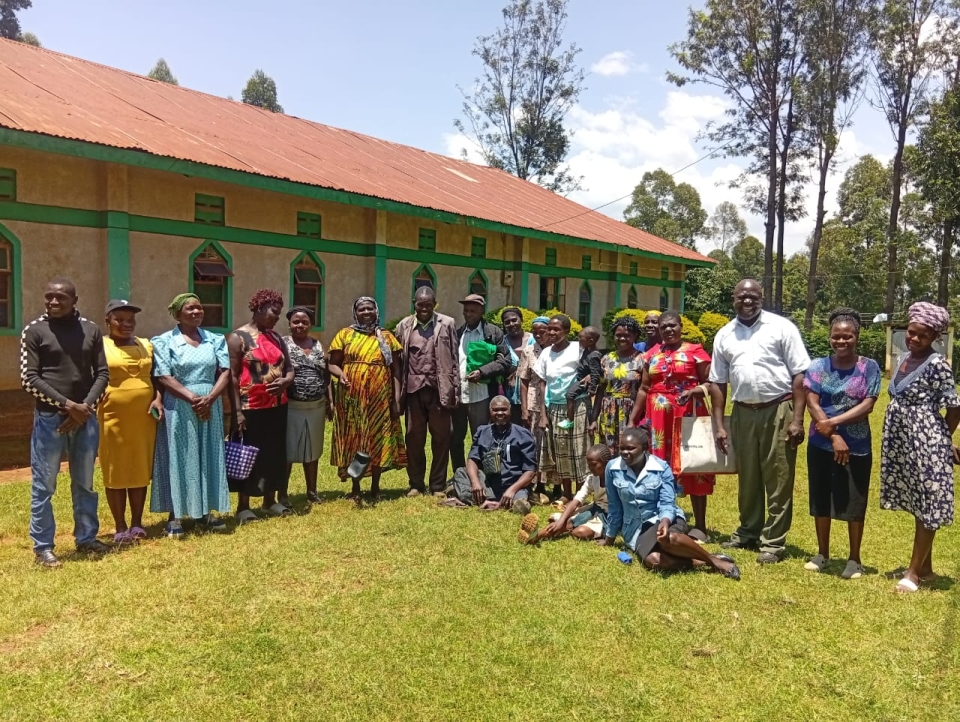
Engaging Men as Allies for Equality and Climate Resilience

Themenfeld: Gender Equality
Gender Equality
Sustainable Livelihoods
Learn&Share: knowhow3000

Problem & Solution

Rural communities in western Kenya faced intersecting pressures: climate-related crop losses, degraded soils, resource disputes, youth exclusion and gender norms that restricted women’s influence over farming, household resources and community leadership. Men often held decision-making authority, while women and girls carried unequal livelihood, care and health burdens.

The solution was to combine participatory dialogue with gender-responsive climate resilience and peacebuilding, engaging men as allies while strengthening women’s and young people’s participation through local farmer groups, schools and peace committees.

The Experience

  • DESECE consulted farmers, women, young people and local leaders to identify climate risks, gender inequalities and conflict drivers, while building trust and local legitimacy.
  • Facilitators used participatory training and dialogue to connect gender equality with climate-smart agriculture, household decision-making and community peacebuilding.
  • Men were approached as influential gatekeepers and encouraged to support women’s leadership and more equitable decisions within households and community structures.
  • Women and girls received complementary support for leadership, livelihoods, rights awareness and school participation, while school clubs enabled young people to share agroecological knowledge with their families.
  • Farmer groups tested climate-smart and locally rooted practices through peer learning, and local institutions served as demonstration and dissemination hubs.
  • Mixed-gender peace committees and youth peace ambassadors combined customary reconciliation with alternative dispute-resolution methods.
  • The organisation later linked community structures with income-generating initiatives and public institutions to support continuity and wider application.
01

Challenges

01

  • Entrenched gender norms and men’s initial role as gatekeepers to women’s participation and leadership.
  • Climate shocks, degraded soils and competition over natural resources undermining livelihoods and social cohesion.
  • Uneven regional needs, requiring stronger conflict sensitivity in some areas and greater livelihood support in others.
  • Slow expansion beyond target communities and sustainability measures introduced relatively late.
02

Impact

02

  • Greater involvement of women in farming decisions, leadership and livelihood activities.
  • Men increasingly supporting women’s participation in households, farmer groups and peace committees.
  • Wider uptake of climate-resilient farming, household gardening and cleaner cooking practices.
  • Young people sharing agroecological knowledge and taking active roles in community peacebuilding.
  • Reduced resource-related conflict and stronger local mediation structures.
03

Lessons Learned

03

  • Engage influential men early through dialogue forums that address concerns before inviting them into visible ally roles.
  • Pair work with men with direct support for women’s agency, ensuring that male engagement does not replace women-led action.
  • Anchor activities in farmer groups, schools and peace committees to maintain participation and spread practices.
  • Combine locally trusted knowledge with new technical methods to strengthen acceptance.
  • Establish conflict safeguards, monitoring and expansion plans from the outset.
Umsetzungszeitraum 2021–2025
Ort Bungoma County, Kenya

Partner Organisation - Development Education Services for Community Empowerment (DESECE)

DESECE started as a CBO in 1993 with DELTA, WINDOW, Civic Education (Human Rights, Peace and Reconciliation), Mainstreaming Gender, and HIV and Aids, and organic Agriculture as its main activities. Due to expanding needs DESECE now also implements Policy Dialogue, Reproductive Health, Community Library, Hospitality and Agro-ecology.

Your choice regarding cookies

This website required cookies in order to function. Technically required cookies stored locally do not collect any personal data. Further technically required cookies are stored by the providers of third party applications.
Additionally, non-essential cookies are collected for analytical purpuses.

You can find out more by visiting our cookie policy linked below.