01.10.2026
Men as Partners in Building Equitable, Climate-Resilient Households
Problem & Solution
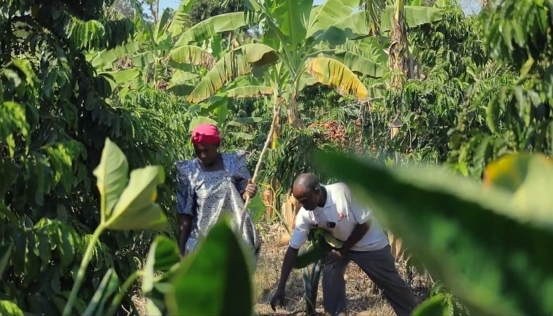
In Rakai and Kyotera districts, climate-related pressures, declining farm productivity and environmental degradation were deepening poverty and food insecurity. Unequal gender norms compounded these pressures: women carried most unpaid care work yet had limited access to land, income, productive resources and household decisions, while many men were not reached through formal groups. This reduced families’ ability to plan jointly, adopt resilient livelihoods and respond to shocks.
Caritas MADDO therefore combined facilitated reflection on gender norms with practical household visioning and planning. Men were deliberately engaged as partners so that women, men and youth could share responsibilities, manage resources more equitably and pursue climate-resilient livelihood goals together.
The Experience
- Caritas MADDO consulted women, men, youth, community leaders and local government to examine barriers to women’s economic participation, resource access and household decisions. A gender analysis and community discussions linked these barriers with livelihood and climate pressures.
- Before community work, staff were trained in gender-transformative facilitation, Social Analysis and Action (SAA) tools, the Gender Action Learning System (GALS) and Do No Harm. Technical partners helped them prepare for sensitive discussions and resistance.
- Facilitators used dialogue to examine gender roles, power, care work and control of resources. Visual tools, including vision journeys, gender balance trees and household plans, turned discussion into shared goals and actions.
- Men and boys were engaged as allies through community gatherings, peer learning and role models. Households tested joint planning, shared care work, equitable resource access, savings and jointly selected enterprises.
- Farmer groups, savings associations, community facilitators, leaders and local government were strengthened to continue promoting gender-transformative approaches beyond the project period.
Challenges
- Deeply rooted norms around land ownership, inheritance and household authority changed slowly and sometimes generated resistance.
- Many men were outside formal groups, making targeted outreach and community-wide dialogue necessary.
- Limited monitoring evidence made it difficult to monitoring of changes in care work, decision-making, resource access, and income.
- Changes in attitudes were often faster than changes in ownership and control of assets. Stronger legal awareness, mediation support, and engagement with customary leaders would be valuable.
Impact
- More joint household planning, budgeting and livelihood decisions, with improved communication and reduced conflict reported.
- Greater participation of women in savings, enterprises and income generation, alongside stronger influence over household choices.
- More sharing of childcare and domestic work, creating time for women’s productive and community activities.
- Broader support for equitable resource access and sustainable farming, although change varied between communities.
Lessons Learned
- Engage men early as partners while keeping women’s agency central; this reduces resistance without reinforcing male control.
- Work with couples where safe, then use repeated mentoring and peer reflection to turn dialogue into sustained practice.
- Households where husbands and wives attended trainings together showed stronger improvements.
- Use visual planning and GALS tools to convert abstract gender concepts into assigned actions, shared goals and reviewable progress.
- Combine behaviour-change monitoring with legal awareness and customary-leader engagement on land and inheritance.

