29.09.2026
School Permaculture Learning Centres Transforming Gender Norms
Problem & Solution
Rural schools in Mpigi faced food insecurity, climate stress, degraded land, and poor sanitation, while gender norms treated the school’s permaculture and menstrual hygiene management as women’s concerns. Men and boys were rarely involved in care or school nutrition; girls experienced teasing, inadequate menstrual support, heavy domestic workloads and disrupted attendance.
AFIRD initially approached permaculture mainly as a food-security intervention, but a participatory gender analysis showed that technical measures alone were not sufficient. The response therefore combined school permaculture learning centres with gender-transformative training, male peer engagement, couple dialogue and formal school committees, making men and boys active partners in nutrition, care, menstrual support and climate-resilient farming.
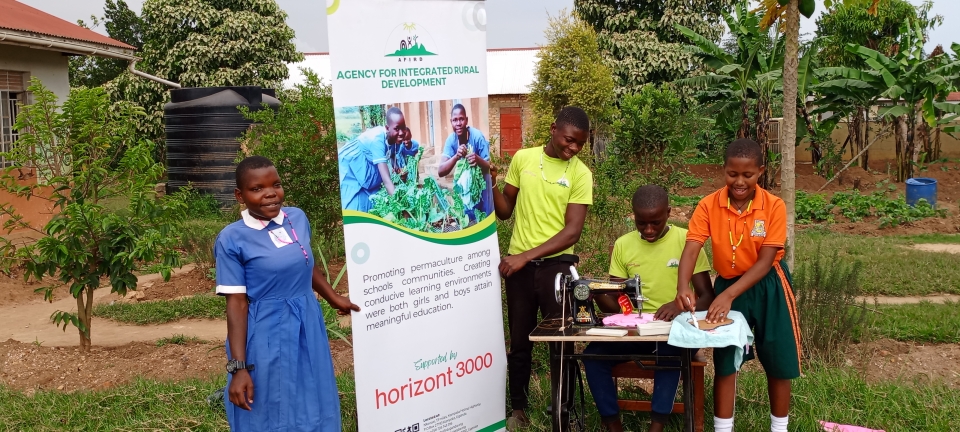
The Experience
- AFIRD began with participatory analyses involving students, parents and teachers. Findings broadened the intervention from food production to gender norms affecting girls’ attendance, care work, menstrual support and school feeding.
- Schools formed gender committees and trained teachers and community champions on equality, gender-based violence prevention and harmful norms. Male agents led peer sessions, while model couples demonstrated shared responsibilities.
- Bare school land was redesigned as permaculture learning centres. Training in soil improvement, water conservation and energy-saving practices included labour sharing, and men and boys received explicit roles so activities were not treated as women’s work.
- Training combined agroecology with business planning, equitable household decision-making, and GBV prevention to avoid the common problem of economic gains being captured by men.
- Schools, community leaders and district officials reviewed findings and agreed to embed sex-disaggregated indicators for male engagement and GBV into district reporting and school plans, and to endorse nutrition days and permaculture land as official practice. This shifted accountability from the project to the district and community level.
Challenges
- Initial resistance from men and boys, reinforced by the belief that permaculture and menstrual support were women’s concerns.
- Early training groups were dominated by women, temporarily increasing their workload.
- Some technologies were adopted slowly without repeated demonstrations and peer support.
- Deeper mainstreaming and stronger male engagement is needed to fully address persistent inequalities and ensure gender equality is embedded in all activities.
Impact
- Stronger support from male teachers, fathers and boys for menstrual hygiene management and girls’ continued attendance.
- School and household gardens improved access to diverse food and practical farming skills.
- Greater sharing of domestic and farming work, allowing women more time for livelihood activities.
- School and district structures assumed responsibility for sustaining the practice.
Lessons Learned
- Using schools as entry points and demonstration centres proved highly effective because they serve as community learning hubs for food security, gender equality, and climate resilience.
- Begin with separate and joint consultations; food-security analysis alone may conceal gender barriers.
- Give men and boys defined, visible responsibilities rather than involving them only as general participants.
- Combine livelihood, household decision-making and GBV-prevention content to reduce the risk of men controlling economic gains.
- Use couple dialogue and time-use reflection to address workload disputes early.