From October 2025 to April 2026, the exhibition Alerta Amazônia toured Austria, presenting 15 arpilleras—hand-sewn textile artworks created by women affected by dams and the climate crisis in the Brazilian Amazon. Produced under the guidance of the Movement of People Affected by Dams in Brazil (MAB) and brought to Austria by horizont3000, the exhibition invited visitors to engage with lived experiences of environmental destruction, resistance, and solidarity.
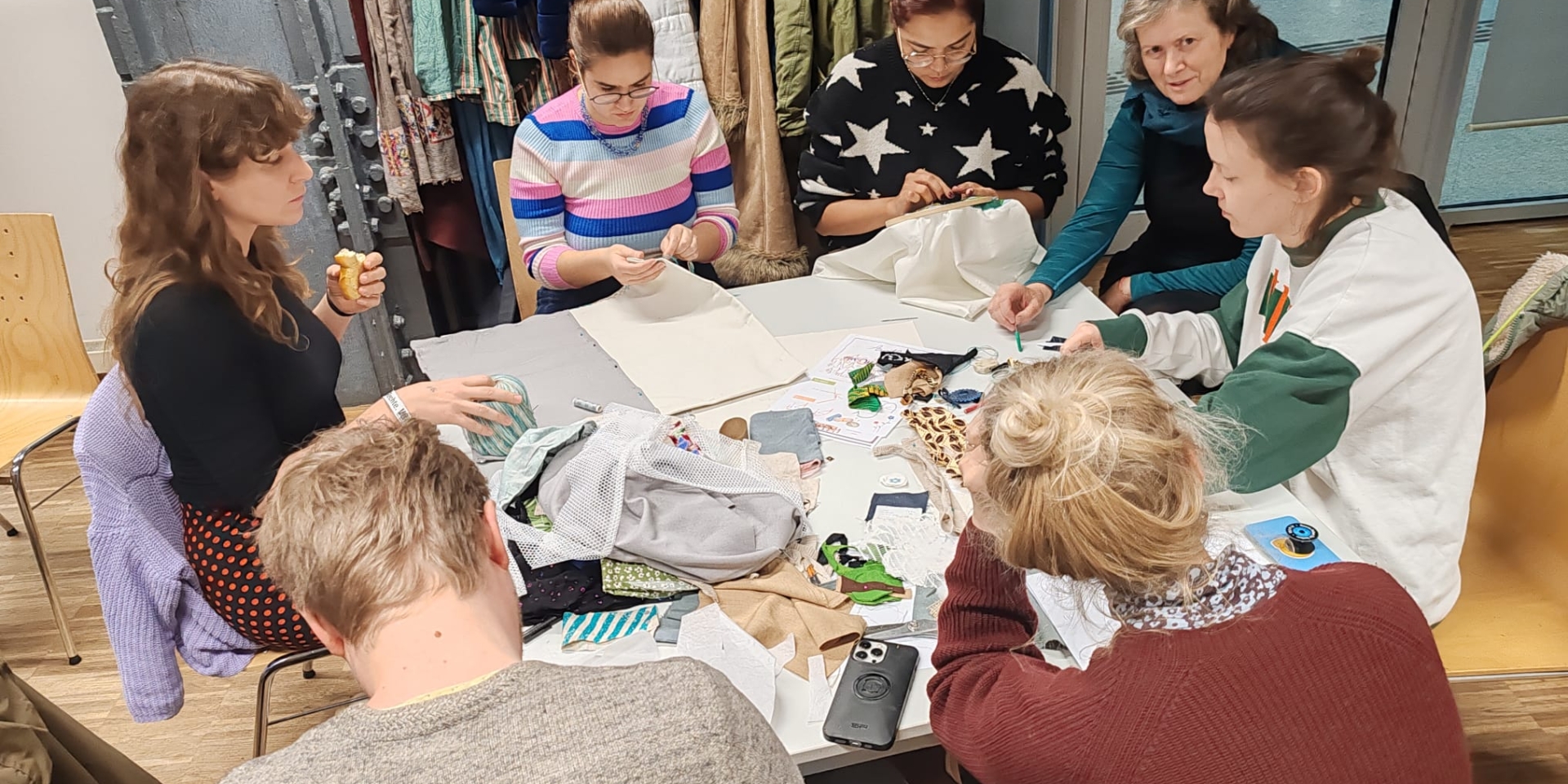
Accompanying the exhibition, horizont3000, the Lateinamerikainstitut, and partner organizations organized workshops with students, pupils, and children. Using the arpillera technique as an educational and political tool, the workshops addressed the climate crisis, the Amazon region, and collective forms of expression. We spoke with workshop facilitators and participants about their experiences.
According to Ana Rocha and Victoria Storfa, who facilitated workshops with upper-secondary Spanish students, participants were particularly struck by the combination of artistic technique and political storytelling: “The students were deeply interested in how textile art can convey complex social and environmental issues. The arpilleras sparked many questions about everyday life in Amazonian communities and about the consequences of deforestation, river pollution, and forest fires.“
The workshops combined visual materials, photographs, and short texts with thematic vocabulary related to the Amazon crisis. “This methodology allowed students to access the content in a more visual and dynamic way,” Rocha and Storfa noted, adding that “even those with limited Spanish skills were able to participate actively and understand the topic better.”
Making their own arpilleras proved to be a powerful experience for the students. Rocha and Storfa describe the process as creative, emotional, and empowering. Students appreciated the opportunity to express ideas and feelings through hands-on artistic work and enjoyed seeing their designs gradually take shape.
At the same time, the process was challenging: “One of the main challenges was translating complex concepts such as climate change or environmental protection into images and textile symbols,” the facilitators said. “Sewing techniques required patience and concentration, but this also led to a strong sense of achievement once the pieces were finished.“
A moment that remains especially vivid was when students began to connect the Amazon crisis to their own realities. “It was very powerful to see them relate what is happening in the Amazon to environmental challenges in their own surroundings,” Rocha and Storfa recalled.
Sebastian Fiebiger, a student at BOKU University and active at the Institute for Development Research, participated in an arpillera workshop led by MAB activists Cleidiane dos Santos Vieira and Sueyla Malcher Bezerra in Vienna. His group chose to focus on the global food system.
“Our arpillera tells the story of our current food system,” Fiebiger explained. “On one side, it shows the cold reality of the dominant market-capitalist system and its tangible effects on people and vulnerable ecosystems. In contrast, the other side represents a world as it once was—and as we hope it can be again, shaped by small-scale agriculture that does not put pressure on our habitats but actively contributes to biodiversity. The scale at the center of the piece symbolizes justice, balance, and harmony. It shows how far out of balance the current system is—but also sends a clear message: there is still a long way to go toward a world where sustainable coexistence is possible.”
For him, the arpillera method was especially effective because it works through images rather than abstract arguments: “Messages can be communicated in many ways, but artistic engagement invites viewers on a journey and gives the message a particular strength.” Asked about the most moving moment, his answer was clear: “The most significant moment was the process itself—the collective, the community that forms through creating together.”
Across all workshops, participants expressed themes of solidarity, care for nature, and hope for the future through their arpilleras. The exhibition and its accompanying activities demonstrated how textile art can function as a bridge—connecting experiences from the Amazon with reflections and responsibilities in Europe, and transforming learning into shared, embodied understanding.
The pieces were presented and integrated into the last stretch of Arpillera Exhibition in the Votivkriche in March and April 2026. The handover of the finished arpilleras at this historical place served as a gesture of solidarity with Amazonian women, and a symbol for bridging different realities shaped by shared challenges such as the climate crisis.
For more information on the exhibition, see: alertaamazonia.com
Also check out the following materials:
The exhibition was part of the project “Climate Justice for the Amazon People” with funds and support from the Austrian Federal Ministry of Agriculture, Forestry, Climate and Environmental Protection, Regions and Water Management; DKA - Austria and Sei so frei Salzburg.